AI in schools is already here—it’s not just a matter for the future
Published: May 26, 2026
Miscellaneous
How can AI actually be used in schools?
This is the central question as teachers from the “ Tellusskolan ” program are currently participating in a training series focused on AI in schools, Gemini, and NotebookLM in collaboration with Google. The training is conducted by Undervisningsdesign and focuses on practical applications in teaching, planning, and administration.
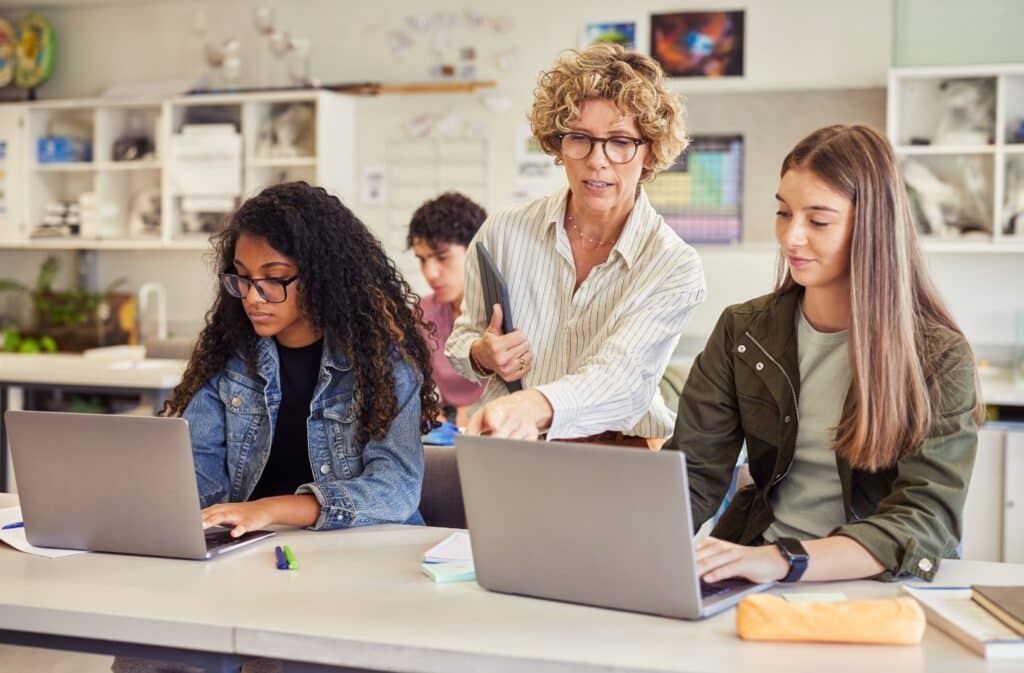
For Anders Noebe, principal at Thea Linköping, the focus is on giving teachers the tools to understand and use technology in a thoughtful way, rather than simply reacting to new developments.
“We see that AI is no longer a matter for the future, but part of our current reality. We want to be a school that is at the forefront and takes responsibility for that development,” he says.
At the same time, he stresses that technology must not distract from what is most important in school.
“AI can take the burden off time-consuming administrative and planning tasks, freeing up more time for face-to-face interaction with students,” says Anders Noebe.
From curiosity to practical application
For Henrik Nyblom, a teacher of geography, social studies, and physical education, his training began with a fairly simple goal.
“I was looking forward to learning more about AI and how it could be applied in my work,” he says.
As the training has progressed, Gemini has become an increasingly natural part of our daily routine.
“It’s now my go-to AI tool when I need to create content,” says Henrik.
Above all, he uses AI to simplify and customize content.
“AI is great at helping me rephrase and simplify content. It saves time and helps me see things in new ways,” he says.
At the same time, there is a clear awareness of the risks.
“As an assistant and sidekick, AI definitely serves a useful purpose, but at the same time we need to be aware of the risks and not view AI as the solution to everything,” says Henrik.
Important conversations about responsibility and critical thinking
Lisbeth Björklund, a teacher of mathematics, science, and technology, believes that great caution and a strong focus on source criticism are still required.
“I think our most important task is to teach students critical thinking and to double-check sources and results,” she says.
At the same time, she sees opportunities in using AI to support the more administrative aspects of the work.
“What AI could help with is compiling information from administrative systems in preparation for, say, performance reviews and tracking absenteeism and results,” says Lisbeth.
For Anders Noebe, it is precisely these different perspectives that are important.
“There has been both curiosity and important questions regarding ethics and assessment. These are exactly the conversations we need to have as a school,” he says.
Teachers' experiences become part of the development process
In parallel with the training program, Kentaur Grundskola is being developed as part of Tellusgruppen. The focus is on AI support for time-consuming tasks in everyday school life, such as planning, documentation, and administration.
Teachers’ experiences are now being directly incorporated into ongoing development efforts. In this way, the training program is aligned with how future work methods and systems are being developed in close collaboration with the organization.
The next step with the students
The training series will conclude in June with a group meeting at Google's office in Stockholm.
In June, educational activities are also planned in collaboration with the students, led by Lovisa Criborn, Head of Education and Product Owner for Kentaur Elementary School. The focus is on exploring AI together, learning from one another, and developing an understanding of both the opportunities and risks.
“We want students to see AI as a driver of creativity and curiosity rather than as a shortcut to cheating,” says Anders Noebe.
These discussions and training initiatives are part of Tellus School’s ongoing work with AI in education and the future of learning.